


Baldi Locks and The Three Hairs
Written By: Health Coach Tonya Fines Because menopause may mess with your hair, but it does not get to steal your humor, confidence, or crown. OMG … utter bliss! Standing

Written By: Health Coach Tonya Fines
Because menopause may mess with your hair, but it does not get to steal your humor, confidence, or crown.
OMG … utter bliss!
Standing under my new rainfall showerhead and the warm water cascading over my body was such a welcome comfort after a long, challenging day. I closed my eyes and let the water take me away … pretty sure I was standing on the beach in Exuma, Bahamas and then … something was amiss with this almost perfect moment.
I opened my eyes to see water pooling around my feet and inching its way up towards my ankles.
DANG … so much for “end-of-day-chill-vibes.”
As I got down on my hands and knees to investigate, I was reminding myself that a clogged drain was not out of the ordinary in my home, however, I was also realizing that the number of times I found myself cleaning the shower drain had drastically increased in the last 2 months.
And thus, the content for my next article was staring me right in the face; much like the mass of slimy, blackened sludge I was pulling from the drain, while trying not to gag.
Welcome to another fun chapter of menopausal madness. Hair thinning!
Can we get a round of applause please. Along with some champagne!
Because apparently, hot flashes, mood swings, mysterious weight gain, sleep disruption, and an unpredictable bladder were not enough. Nope. Menopause looked around and said, “You know what else would be fun? Let’s add to her anxiety by making her question every single strand of hair on her head.”
Fabulous.
Just fabulous.
Now, if you’ve ever stood in the shower holding a clump of hair and whispered, “Is this normal?” while simultaneously trying not to spiral into a full-blown emotional crisis, please know this …
Girl, you are not alone.
There is something deeply personal about hair. For many women, our hair is tied to identity, femininity, confidence, sensuality, personality, and how we show up in the world. It is not “just hair,” no matter how many people try to tell us that.
It is our curls.
Our volume.
Our signature style.
Our messy bun.
Our blowout.
Our ponytail.
Our crown.
So, when it starts thinning, shedding, breaking, or showing more scalp than we are emotionally prepared for, it can feel like yet another betrayal from a body we are already trying very hard to understand.
And yes, I know there are bigger problems in the world.
But also, clogged shower drains filled with your own hair are not exactly a spa experience.
The Root Causes of Menopausal Hair Thinning
1. Estrogen: Your Former Best Friend
Estrogen plays a huge role in keeping your hair thick and healthy. It helps extend the hair growth phase, known as the anagen phase, which just means that your strands stay put longer before naturally shedding.
However, when estrogen levels drop during menopause, that growth phase may shorten, leading to increased shedding and slower regrowth.
Oh GOODY!
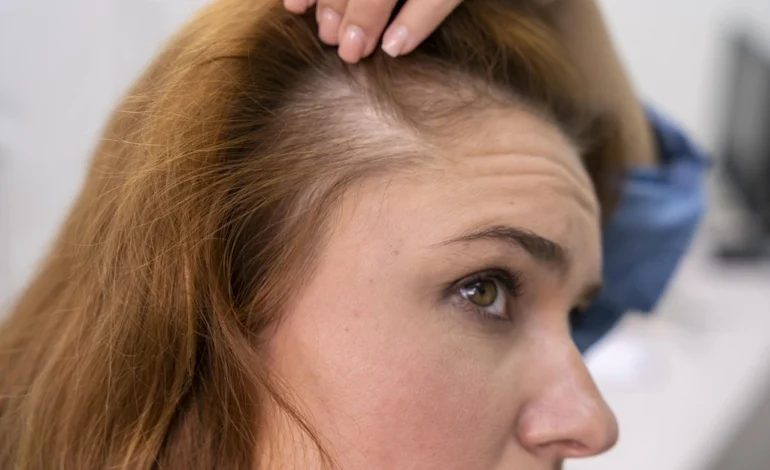
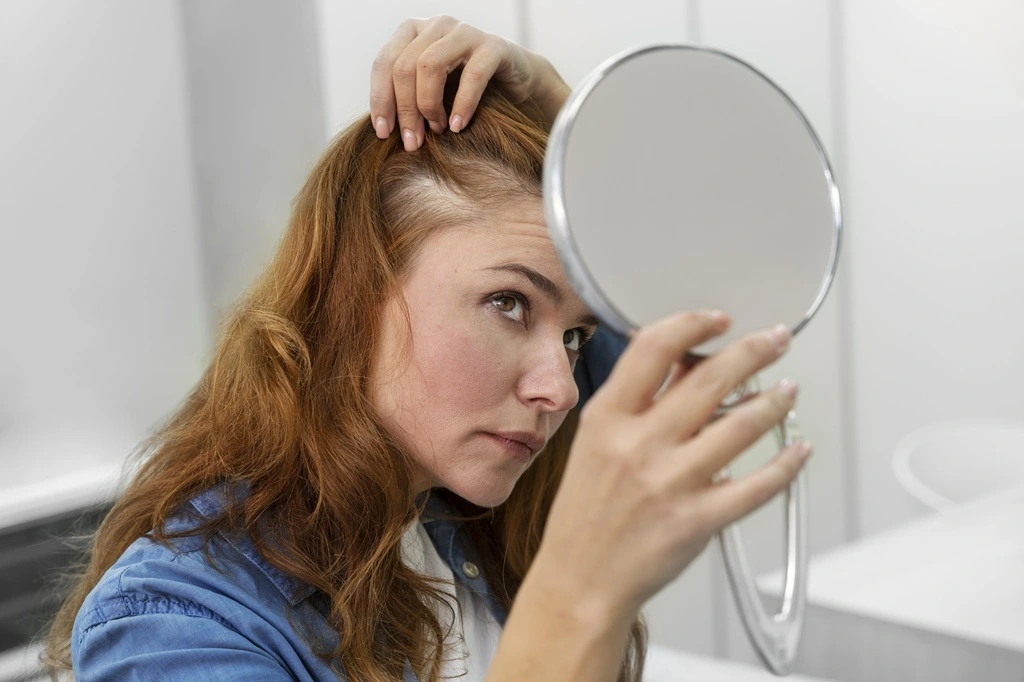
And here’s where it can feel so confusing. You may not wake up one morning bald. It may be much sneakier than that. You may notice your ponytail feels smaller. Your part looks a little wider. Your hairline feels thinner. Your curls don’t have the same bounce. Your scalp appears in lighting that you are now convinced was designed by someone cruel.
And bathroom lighting? Honestly, who approved that?
No menopausal woman needs overhead fluorescent lighting while she is already questioning her entire follicular future.
2. Testosterone: The Sneaky Villain
Now, while estrogen is taking a backseat, testosterone, the hormone that’s always been lurking in the background, sees an opportunity to shine.
Well DUH!
Testosterone can convert into dihydrotestosterone, also known as DHT, a hormone that loves to shrink hair follicles, making them produce thinner, weaker hair until eventually, they may stop producing hair altogether.
So, if you’ve ever looked at your husband’s receding hairline and thought, “Oh you poor fella,” well … guess what?
DHT isn’t just HIS problem anymore.
I like to think of it as us being supportive team players!
But in all seriousness, this is one of the reasons menopause-related hair changes can feel so unfair. It is not always just about shedding. Sometimes the actual diameter of the hair strand becomes finer. The hair that grows back may not feel as strong or thick as it once did.
And this is why women may say things like, “I still have hair, but it is not my hair.”
That sentence hits, doesn’t it!
Because when your texture, density, and volume change, it can feel like yet another part of you is shifting without your permission.
3. Nutrient Absorption Takes a Hit
Menopause can affect your body’s ability to absorb and utilize key nutrients like iron, biotin, vitamin D, B vitamins, zinc, and protein, which are all important for healthy hair.
So, even if you’re eating well, your hair might not be getting the nourishment it needs.
And let’s talk about protein for a second, because this one matters. Hair is made primarily of a protein called keratin, so if you are under-eating, dieting aggressively, skipping meals, losing weight quickly, or not getting enough protein, your hair may decide it is not a priority.
Your body is very smart.
Annoyingly smart sometimes.
It will prioritize survival over fabulousness every single time.
Therefore, if your body is under stress, undernourished, inflamed, exhausted, or trying to navigate hormonal changes, your hair may end up lower on the priority list.
Rude, but efficient.
This is also why crash dieting, rapid weight loss, illness, surgery, intense stress, or major life events can trigger shedding. Sometimes the hair loss we see today is connected to stress the body experienced several months ago. So, while we are blaming the shampoo, the brush, the pillowcase, the showerhead, and maybe even the moon, the real trigger may have happened much earlier.
Again, very rude.
4. Stress … The Ultimate Hair Thief
Let’s be honest, menopause itself is stressful, right?!
Between night sweats, mood swings, weight gain, an unpredictable bladder and spontaneous flatulence, adding hair loss to the mix is just cruel.
But here is what you need to understand: stress increases cortisol levels, which can disrupt hair growth cycles and accelerate shedding.
More applause. And yes, insert sarcastic tone.
Honestly, when we are stressed about losing hair, that stress can create its own vicious little cycle.
We notice more hair shedding.
We panic.
We check the mirror forty-seven times a day.
We inspect the shower drain.
We examine the hairbrush like a forensics expert.
We take photos of our part in bad lighting.
We Google menopausal hair loss at 1:00 a.m., which, by the way, is rarely a path to inner peace.
Then we become more stressed.
And the body says, “Oh good, more cortisol. Let’s keep the chaos going.”
No thank you.
This is where nervous system support becomes important. Not because deep breathing magically regrows your hair overnight, although wouldn’t that be lovely. But because your body needs to feel safe enough to heal, repair, and function well.
That may look like walking, yoga, prayer, meditation, journaling, time in nature, laughter with your girlfriends, or simply taking ten minutes where no one is asking you where the peanut butter is.
Which, by the way, is probably exactly where it always is.
5. Thyroid Troubles & Other Medical Conditions
Hair thinning can also be linked to thyroid imbalances, another common issue during midlife and menopause. If you’re experiencing extreme hair loss, it’s worth checking in with a healthcare provider to rule out underlying conditions like hypothyroidism, anemia, low ferritin, vitamin D deficiency, autoimmune issues, or other medical concerns.
And please hear me on this …
Do not let anyone dismiss you with, “Well, you’re just getting older.”
No ma’am.
Yes, hormonal changes are real.
Yes, aging plays a role.
Yes, menopause can absolutely affect hair.
But that does not mean you should ignore significant shedding, patchy loss, scalp pain, sudden changes, or symptoms like fatigue, cold intolerance, dizziness, heart palpitations, heavy bleeding before menopause, or anything else that feels off.
Your hair can be a messenger.
And sometimes the message is, “Hey babe, we need to look a little deeper here.”
So yes, laugh about the drain if you can.
Make the Baldilocks jokes.
Whisper sweet nothings to your remaining strands.
But also advocate for yourself.
Ask for labs.
Ask questions.
Work with a knowledgeable practitioner.
And if needed, see a dermatologist who specializes in hair loss or a qualified trichologist.
Because the goal is not to panic.
The goal is to understand.
The Baldilocks Sisterhood
Now here is the good news … you’re not alone.
Nope, we are the “Baldilocks Sisterhood.”
If you’ve ever cried while on your hands and knees cleaning the shower drain over lost strands in the shower, then know this … millions of menopausal women are in the same boat.
As a matter of fact, a 2022 study published in the journal, Menopause, found that more than half of postmenopausal women in the study experienced female pattern hair loss. That means that in every yoga class, office meeting, or girls’ night out, there are likely other women silently checking their parts, fluffing their hair, and avoiding the one bathroom mirror with the lighting that shows absolutely no mercy.
Strand-Saving Solutions for Menopausal Hair Loss
Feed Your Follicles
Check Your Shampoo & Styling Routine
Scalp Massages & Hair Oils
Talk to a Professional About Evidence-Based Options
Stress Less
Be Kind to the Woman Under the Crown
Now gals, the big takeaway I would really love for you to all get out of this article is this …
You are not Baldilocks all alone in the woods.
We’re all in this menopausal adventure together … three hairs and all!
Wish me luck.
Contact Tonya – https://www.linkedin.com/in/tonya-fines/