





Clinical Case File: When ‘Autoimmune Fatigue’ Hid a Treatable Sleep Disorder
By Alison Kole, MD, MPH, FCCP, FAASM This is a de-identified clinical case based on a real patient. Details have been changed to protect privacy, but the medical story—and the


By Alison Kole, MD, MPH, FCCP, FAASM
This is a de-identified clinical case based on a real patient. Details have been changed to protect privacy, but the medical story—and the missed diagnosis—are very real.
Everyone Thought the Answer Was Obvious
She was in her mid-30s when her body turned on her.
First came rheumatoid arthritis.
Then lupus.
Two autoimmune diseases before 40, and what seemed destined to be a lifetime of pain ahead.
Everyone around her agreed on one thing: of course she was exhausted.
Of course she couldn’t sleep.
The explanation seemed simple—chronic pain, chronic inflammation, terrible sleep.
End of discussion.
No one stopped to ask whether something else might also be happening.
The Symptoms Were Hiding in Plain Sight
If you live with autoimmune disease, this story may sound familiar.
Her Nights Looked Like This
- Tossing and turning, “tired but wired”
- Waking multiple times every night, often achy and in pain
- Several trips to the bathroom overnight
- Loud snoring and choking sounds that her husband had gradually come to accept as normal
Her Days Weren’t Any Better
- Bone-deep fatigue that felt completely out of proportion to her lab results
- Brain fog so severe she reread the same paragraph over and over
- More pain
- More stiffness
- More flares
Every symptom had an “obvious” explanation.
Autoimmune disease.
Medications.
Menopause.
Stress.
But none of those explanations led to real relief.
One Simple Question Changed Everything
Everything changed when a new clinician did something remarkably simple.
Instead of assuming the fatigue belonged to rheumatoid arthritis or lupus, they looked at her husband and asked:
“Does she snore?”
That one question led to a home sleep study.
The results told a very different story.
On paper, she had mild obstructive sleep apnea.
But during REM sleep—the stage when muscles relax and the brain performs much of its overnight recovery—the disease becomes severe.
Her oxygen levels dropped into the low 80s.
While the rest of the world slept, her heart and brain were running a marathon every single night.
It wasn’t just rheumatoid arthritis.
It wasn’t just lupus.
Sleep apnea had been riding shotgun for years.
What Happened After Treatment
Starting CPAP wasn’t easy.
She worried about wearing a mask.
She worried about the noise.
She worried that needing a machine somehow meant she had become “sick enough.”
But little by little, things began to change.
The First Improvements
The gasping awakenings stopped.
The 3 a.m. bathroom trips went from four every night to one—or sometimes none.
Morning stiffness didn’t disappear, but it became less explosive.
Getting Herself Back
Perhaps most importantly, her brain fog began to lift.
For the first time in years, she felt like herself again.
Her autoimmune diseases didn’t disappear.
She still had rheumatoid arthritis.
She still had lupus.
But for the first time in decades, sleep was finally helping her body instead of hurting it.
She realized something profound.
The “autoimmune fatigue” everyone had accepted as unavoidable was, at least in part, untreated sleep apnea.
Why People With Autoimmune Disease Should Care About Sleep Apnea

Research continues to tell the same story.
What We Know
People living with autoimmune diseases like rheumatoid arthritis and lupus have higher rates of obstructive sleep apnea than the general population.
Some studies have found that more than half of patients with rheumatoid arthritis meet criteria for sleep apnea during formal testing.
Among people with lupus, both sleep apnea and poor sleep quality are more common and are often associated with more active disease.
Poor sleep—whether caused by sleep apnea or chronic insomnia—can worsen:
- Pain
- Fatigue
- Mood
- Cognitive function
- Immune system regulation
The Takeaway
If you have autoimmune disease and you’re still exhausted despite “good” laboratory results and optimized medications, sleep apnea isn’t a long shot.
It may be a missed diagnosis waiting to be found.
Her New Mission
Today, she still lives with rheumatoid arthritis.
She still lives with lupus.
She still has pain.
But she also has more energy—and a new mission.
She shares her story in waiting rooms, infusion centers, and group chats.
“If you live with autoimmune disease and you wake up exhausted no matter what you do, please ask about sleep apnea. Don’t let them stop at, ‘It’s just your disease.'”
At her most recent rheumatology appointment, she advocated for one simple change.
She asked that every intake form include a few quick sleep questions.
Three Questions That Could Change Everything
- Do you snore?
- Has anyone noticed gasping or choking during your sleep?
- Do you wake feeling unrefreshed?
It’s not a cure.
But it may be how people like her are found sooner.
Could This Be More Than Autoimmune Disease?
If this story sounds familiar, you’re allowed to ask your healthcare provider:
“Could this be more than just my autoimmune disease?”
“Can we talk about screening me for sleep apnea?”
You’re not asking for “extra.”
You’re asking for the kind of sleep that gives your body a fighting chance.
Screenshot This and Bring It to Your Next Appointment
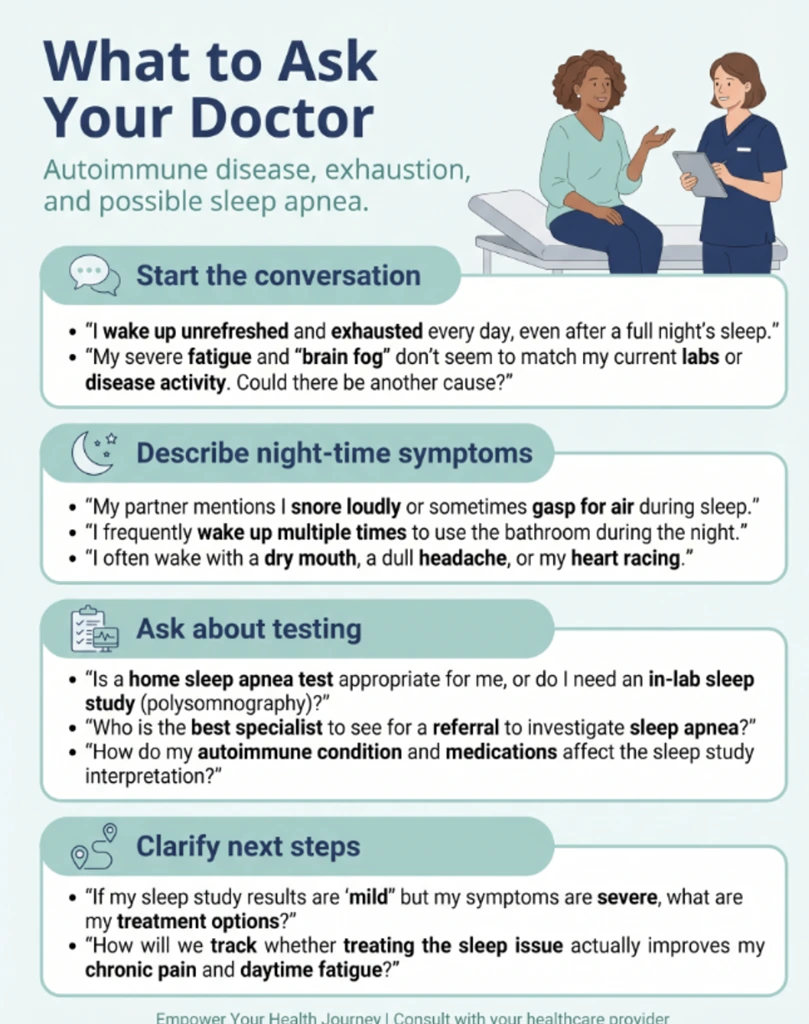
Ask Your Healthcare Provider About Sleep Apnea If You Have Autoimmune Disease AND You Experience:
✓ Loud snoring
✓ Gasping or choking during sleep
✓ Waking multiple times overnight
✓ Frequent nighttime bathroom trips
✓ Morning headaches
✓ Brain fog
✓ Fatigue that feels worse than your lab results suggest
✓ Unrefreshing sleep despite spending enough time in bed
✓ Persistent exhaustion despite well-controlled rheumatoid arthritis, lupus, or other autoimmune disease
Ask:
“Could I be screened for obstructive sleep apnea?”
Sometimes the missing piece isn’t another medication.
Sometimes it’s finally getting restorative sleep.
For more information on Alison Kole visit: https://www.askthesleepmd.com/