




The Black Dahlia. The Paige Collett Story and the Art of the Undying Spirit.
Written by Matt Canada Brown for Ravoke.com In the world of professional wrestling, there is a distinct line between those who play a character and those who inhabit a legend.


Written by Matt Canada Brown for Ravoke.com
In the world of professional wrestling, there is a distinct line between those who play a character and those who inhabit a legend.
Paige Collett, known to the squared circle as “The Black Dahlia” or “The Chainsaw Queen,” doesn’t just cross that line, she sets it on fire.
To look at Paige’s career is to look at a curriculum of grit. In the brutal, high-stakes environment of deathmatch wrestling, the physical toll is not a possibility; it is a guarantee.
But as we explore the transition from an “active life” to one shaped by the consequences of that activity, Paige stands as a pivotal example of what it means to survive, evolve, and remain sovereign over your own story.
Paige Collett didn’t enter the ring looking for a spotlight; she entered it looking for a battle.
Trained by legends of the craft, she brought a gothic, relentless energy to the independent circuit. But it was her evolution into the Black Dahlia that solidified her status as a cult icon.
Deathmatch wrestling is often misunderstood by the mainstream. It is seen as mere carnage, but for those in the trenches, it is a high-stakes performance of human endurance.
For Paige, the ring was a place where physical limits were tested and broken. It was an “active life” in its most extreme form, where the “before-injury” life is a constant gamble against the “after-injury” reality.
Every athlete eventually faces the “Great Transition.”
For Paige, this journey involved navigating a freak in-ring injury that left her with Complex Regional Pain Syndrome (CRPS).
The shift from being a person whose identity is tied to physical dominance to a person navigating the weight of recovery is a quiet trauma. It is the moment I’ve spoken about often: Who am I now?
For Paige, the answer hasn’t been to disappear. Like a true warrior, she has moved into a space of reflection and adaptation.
The “The Black Dahlia” moniker isn’t just a gimmick; it’s a metaphor.
It’s a metaphor for cutting through the noise of a society that expects injured athletes to fade away.
In the natural world, the Dahlia is a symbol of inner strength and staying standing under pressure. But the Black Dahlia carries a heavier, more shadowed weight.
For Paige, this name has evolved from a gothic aesthetic into a literal representation of her “true form” to the world.
The Black Dahlia represents a beauty that is born from the shadows.
To the outside world, CRPS is often seen as darkening.
A shadow that falls over an active life. But for Paige, the “Black Dahlia” isn’t about the darkness that consumes; it’s about the fire that burns within it.
Like the flower that blooms best in the cool, hard earth, Paige has used the “darkness” of her diagnosis to root herself deeper into her craft.
CRPS is often called the “Suicide Disease” because of its unrelenting intensity, but for the Black Dahlia, that intensity is not a cage, it is an element she has learned to weaponize.
When she steps into the ring today, she isn’t fighting in spite of the pain; she is fighting with it.
Much like the sharp contrast of a black petal, Paige’s existence is one of extremes.
There is the extreme agony of the “fire” in her nerves, met by the extreme fire of her will to compete.
Society often wants those with CRPS to be invisible, to stay in the “dark.” By keeping the name Black Dahlia while actively competing, Paige is showing the world her true form: a woman who has integrated her pain into her power.
She is the living embodiment of the idea that you can be broken and beautiful, wounded and lethal, all at once.
For many, the ring is a place to escape reality.
For Paige, the ring is where her reality is finally understood.
The high-impact, high-adrenaline environment of professional wrestling is the only place where the internal “fire” of CRPS meets an external force of equal magnitude.
Her fire isn’t fueled by a need for a title or a trophy; it is fueled by the defiance of a woman who was told her body was a “loss.”
Every bump she takes and every strike she delivers is a message to the medical institutions, the skeptics, and the disease itself: The Queen is still on her throne.
By refusing to drop the name or the persona, Paige provides a blueprint.
A blueprint for the “Warriors and Survivors” of our community.
She proves that identity is sovereign. You can take the “horror” of a diagnosis and turn it into a legendary persona.
Pain can be a Teacher.
It has sharpened her focus, turned her into a “Scream Queen” of cinema, and made her a more dangerous, more calculated presence in the ring.
Her “true form” isn’t the injury, it’s the relentless spirit that continues to walk through the fire, chainsaw in hand, refusing to let the flame go out.
In my 10 years of advocacy, I have seen how society treats those who have given their bodies to their craft.
When an athlete like Paige faces the physical toll of her career, the world often looks for “pity” rather than “innovation.”
Paige’s story is essential for the Ravoke and Trial by Fire community because it highlights the three pillars of survival.
The Loss of Routine.
Moving from the adrenaline of the crowd to the quiet of the clinic.
Systemic Disbelief.
The struggle to have the long-term impacts of physical sacrifice taken seriously.
Rebuilding Identity.
Finding a way to keep the “Warrior Spirit” alive when the method of battle has to change.
Despite a diagnosis that many call the “Suicide Disease” due to its relentless agony, Paige has done the impossible.
She hasn’t just survived; she has reloaded.
By diversifying her brand, she has transitioned her “Appalachian Slasher” persona from the wrestling mat to the silver screen, carving out a new legacy as a rising force in horror cinema.
Acting serves as more than a career for Paige; it is distraction as medicine.
On a film set, just like in the ring, the focus is so intense that the CRPS signals must compete for space.
She has taken the “horror” of her pain and turned it into the “horror” of her art, a masterclass in reclaiming one’s narrative.
As the CRPS community continues to evolve, people like Paige serve as a reminder.
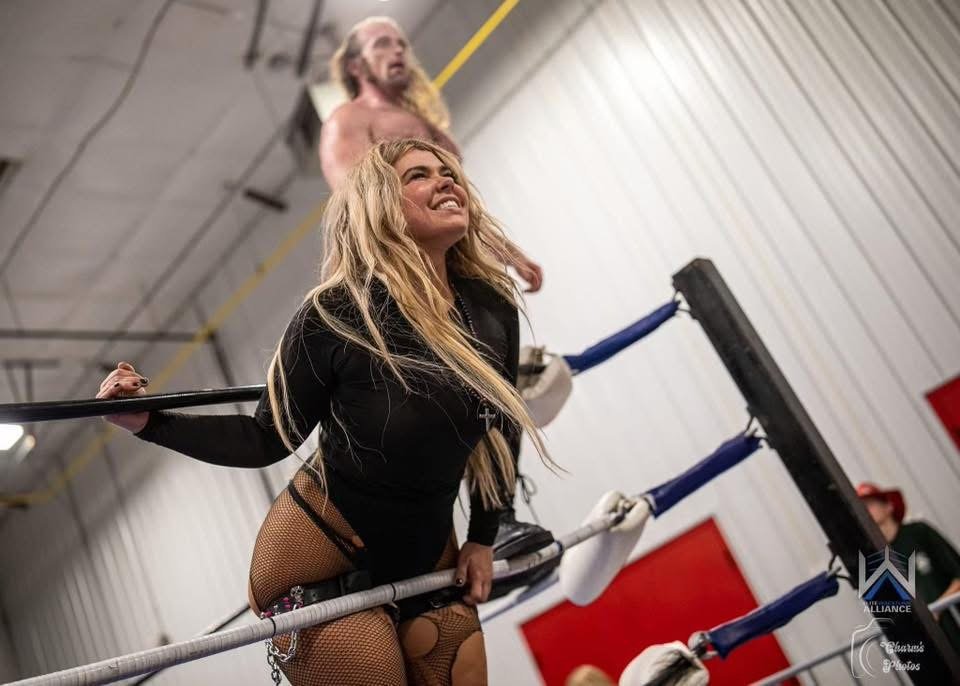
We may move from “active” to “adaptive,” but the core of who we are, the “Black Dahlia,” and the “Chainsaw Queen,” forever stay intact, becoming part of all CRPS Warriors.
We are not our injuries. We are the architects of what comes next.
CRPS FAQ (Complex Regional Pain Syndrome)
What is CRPS?
CRPS, or Complex Regional Pain Syndrome, is a chronic neurological pain condition that usually develops after an injury, surgery, or trauma. The pain experienced is often far more severe and long-lasting than the original injury would suggest.
Is CRPS a real medical condition?
Yes. CRPS is a medically recognized neurological disorder acknowledged by institutions such as the NIH and Mayo Clinic. Despite this, many patients still face skepticism due to its complexity and invisibility.
Why is CRPS sometimes called the “Suicide Disease”?
CRPS is often referred to as the “Suicide Disease” because of its relentless, burning pain and the emotional toll of living with a condition that is frequently misunderstood, misdiagnosed, or dismissed. This label reflects the severity of suffering—not inevitability. Many people with CRPS survive, adapt, and rebuild meaningful lives.
What does CRPS pain feel like?
CRPS pain is commonly described as:
- Burning or electric
- Crushing or stabbing
- Hypersensitivity to touch or temperature
Even light contact, clothing, or airflow can feel unbearable.
Can CRPS be cured?
There is currently no known cure for CRPS. However, early diagnosis and treatment can significantly improve outcomes. Many people manage symptoms through a combination of medical care, physical therapy, mental health support, and adaptive strategies.
Does CRPS only affect one limb?
CRPS often starts in one limb, but it can spread to other areas of the body over time. The pattern and progression vary widely from person to person.
To learn more about Paige Collett, and her story, follow her on social media via:
https://www.facebook.com/people/Paige-Collett
https://www.instagram.com/blackdahlia47