




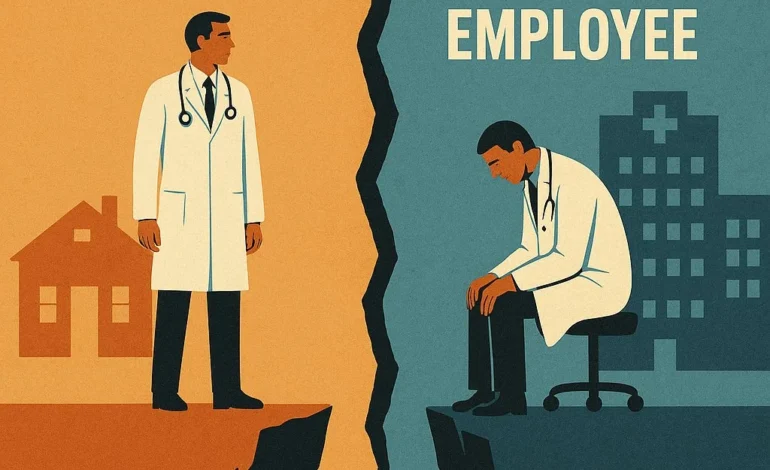
Doctor vs. Controlled Employee: How Modern Healthcare Engineered Compliance Over Care
Fourteen years ago, I was diagnosed with Type 2 diabetes. At the time, I didn’t understand that this diagnosis would become more than a medical event — it would become

Fourteen years ago, I was diagnosed with Type 2 diabetes. At the time, I didn’t understand that this diagnosis would become more than a medical event — it would become a case study in how modern healthcare has quietly redefined its priorities.
I was stunned, not only by the diagnosis itself, but by how quickly it was reduced to a transaction.
A finger-prick blood test. A brief explanation. A prescription.
What never came was a conversation.
The Absence That Speaks Loudest
The physician who diagnosed me was visibly overweight by at least 50 pounds. This is not about judgment; it is about contradiction. He recommended medication immediately, without addressing the most obvious and modifiable drivers of Type 2 diabetes: weight, nutrition, physical activity, and metabolic health.
- No structured plan.
- No timeline for lifestyle intervention.
- No acknowledgment that Type 2 diabetes often develops over years and can, in many cases, be reversed or significantly improved.
The absence of that conversation was not an oversight. It was a feature of the system.
From Healers to Operators
To understand how we arrived here, we need to understand what has happened to physicians.
Modern doctors are no longer independent practitioners in any meaningful sense. Most are employed by hospital systems, corporate healthcare networks, or private equity–backed groups. Their clinical autonomy has been steadily eroded by layers of administrative oversight, performance metrics, and reimbursement requirements.
Medicine is now practiced within tightly controlled parameters:
- Standardized treatment algorithms
- Time-limited patient encounters
- Documentation designed for billing, not understanding
- Legal frameworks that punish deviation
Clinical judgment, once the cornerstone of medical practice, has become a liability.
The Legal and Economic Straitjacket
Physicians today practice under constant threat of lawsuits, audits, and professional discipline. This fear shapes behavior far more than most patients realize.
Prescribing medication that aligns with established guidelines offers legal protection. Recommending lifestyle intervention alone, even when medically sound, can expose a doctor to risk if outcomes are unfavorable.
In this environment, defensive medicine is not cowardice—it is survival.
The safest path is also the most profitable one.

Type 2 Diabetes and the Illusion of Management
Type 2 diabetes has been reframed as a chronic, progressive disease that must be “managed” for life. This framing is extraordinarily convenient for a system built around recurring revenue.
What is rarely emphasized is that:
- Weight loss can restore insulin sensitivity
- Dietary change can normalize blood glucose
- Physical activity alters metabolic pathways
- Stress and sleep profoundly affect glycemic control
None of these interventions generate predictable billing cycles. None fit neatly into a 10-minute appointment. And none benefit pharmaceutical shareholders.
So they are sidelined.
The AI Acceleration Problem
Artificial intelligence has not created these issues—it has intensified them.
AI systems are being deployed to:
- Optimize patient throughput
- Standardize clinical decision-making
- Maximize billing efficiency
- Reduce human variability
In theory, this should free doctors to focus on care. In practice, it tightens the system’s grip. Algorithms increasingly dictate what is “appropriate,” leaving less room for nuance, context, or human judgment.
AI does not ask whether a patient has the capacity to change their life. It asks whether a protocol has been satisfied.
And protocols monetize better than people.
The Quiet Exodus of Ethical Physicians
One of the least discussed consequences of this system is the growing number of doctors who are leaving medicine altogether.
I have spoken with physicians who describe:
- Moral injury from practicing against their values
- Exhaustion from administrative overload
- Fear of speaking honestly with patients
- A sense of futility within an unchangeable system
These are not underperforming clinicians. They are often the most thoughtful ones.
When healers leave, what remains is a system optimized for compliance, not care.
Patients as Lifetime Customers
From an economic perspective, a cured patient is a lost customer.
Chronic disease management, by contrast, provides:
- Predictable revenue streams
- Long-term pharmaceutical use
- Recurrent monitoring and testing
- Ongoing specialist referrals
This is not a conspiracy—it is a business model.
The tragedy is that many patients never realize that alternatives existed but were never presented.

The Ethical Collapse at the Center
Healthcare has not failed because of bad people. It has failed because incentives shape behavior more powerfully than intentions.
When speed is rewarded over listening, listening disappears.
When compliance is safer than curiosity, curiosity dies.
When profit outpaces prevention, prevention becomes rhetoric.
Doctors become controlled employees.
Patients become managed assets.
Health becomes secondary.
What True Reform Would Require
Real reform would mean:
- Reimbursing time spent on education and lifestyle intervention
- Protecting physicians who practice individualized medicine
- Reducing pharmaceutical-first mandates
- Measuring success by health outcomes, not utilization
These changes threaten powerful financial interests—which is why they remain largely theoretical.
The Seduction of the Magic Pill
Modern medicine has developed an almost reflexive urgency to fix people quickly. Symptoms are treated as mechanical failures, and the solution is expected to be immediate, measurable, and preferably pharmaceutical. The idea that healing might require sustained effort, discomfort, discipline, and personal responsibility has become deeply unfashionable.
The “magic pill” is seductive—not only to patients, but to the entire healthcare ecosystem.
For patients, it offers relief without disruption. No fundamental changes. No reorganization of life. No confrontation with habits, stress, trauma, or environment. Just compliance. Take this. Come back in three months. Adjust dosage if necessary.
For physicians, it offers protection. Prescribing medication aligns with established guidelines, satisfies insurance requirements, and provides legal insulation. It is faster, defensible, and quantifiable. Lifestyle change, by contrast, is messy. It depends on human behavior, socioeconomic realities, psychological resilience, and time—luxuries the modern system does not reward.
For the system, the magic pill is perfection.
Hard Work Does Not Scale Well
Lifestyle-based healing—weight loss, nutritional change, physical activity, stress management—demands time, education, follow-up, and trust. It does not scale cleanly. It cannot be reduced to a billing code or automated by an algorithm.
Hard work is inherently inefficient.
You cannot rush metabolic repair. You cannot algorithmically force insulin sensitivity. You cannot automate accountability. These processes unfold unevenly, require coaching, and often include setbacks. From a human standpoint, this is reality. From a corporate standpoint, it is a liability.
The system does not fail to emphasize lifestyle change because it doesn’t work. It fails to emphasize it because it works too slowly—and too independently.
The Cultural Intolerance for Delay
We now live in a culture that views delayed gratification as a defect. If improvement does not occur rapidly, it is deemed unacceptable. Medicine has absorbed this mindset wholesale.
A patient diagnosed with Type 2 diabetes is often not asked, “Are you willing to work?” but rather, “How quickly can we normalize the numbers?” Blood glucose becomes the objective, not metabolic health. A lab value becomes more important than the process that produced it.
Medication delivers speed. Lifestyle delivers depth.
But depth takes time—and time is what the system no longer allows.
Read About: 10 Smart Ways to Manage Type 2 Diabetes and Protect Your Heart
Pills Transfer Responsibility Away From the System
There is another uncomfortable truth: medications shift responsibility.
When a pill is prescribed, the burden of outcome is transferred almost entirely to the patient’s compliance. If numbers worsen, the answer is dosage escalation or drug addition—not system introspection.
If lifestyle intervention fails, however, uncomfortable questions arise:
- Was the patient properly educated?
- Were social and economic barriers addressed?
- Was adequate time provided?
- Was ongoing support available?
These questions expose structural inadequacies. Pills conceal them.
The False Binary of Effort vs. Compassion
The rush toward medication is often framed as compassion. Suggesting hard work can be portrayed as judgmental or unrealistic. But this framing creates a false binary: either we medicate, or we shame.
That is a lie.
True compassion does not remove agency. It strengthens it. It says, “This will be difficult, but you are capable—and we will support you.” The magic pill culture quietly communicates the opposite: “This is too hard for you. Let the system handle it.”
Over time, patients internalize this message. They stop believing their actions matter.
When Convenience Replaces Cure
The ultimate tragedy of the magic pill mentality is not dependency—it is resignation.
Patients come to believe that decline is inevitable, that disease is their identity, and that management is the ceiling of possibility. The language of “lifelong treatment” replaces the language of recovery.
This resignation is profitable. It is predictable. And it is devastating.
Hard work threatens this model because it introduces uncertainty—and hope.
The Question That Remains
The question is no longer whether modern healthcare can manage disease. It clearly can.
The question is whether it still remembers how to heal.
Until that question is confronted honestly, diagnoses like mine will continue to mark the beginning of a lifelong transaction rather than an opportunity for transformation.
And that is the deeper illness we refuse to name.
Read the journey of Adam Fiore on his diabetes transformation
FAQ
Is Type 2 diabetes always progressive?
No. While often labeled as progressive, many cases improve significantly or enter remission with sustained lifestyle changes.
Why are lifestyle interventions not emphasized?
They are time-intensive, difficult to standardize, and poorly reimbursed compared to medications.
Are AI systems inherently harmful in healthcare?
No, but when aligned with profit rather than patient-centered outcomes, they amplify existing problems.
Why don’t more doctors speak out?
Fear of litigation, job loss, and professional isolation keeps many silent.
What can patients do?
Ask questions, request alternatives, and seek practitioners who prioritize education and shared decision-making.
About the Author
Charles Mattocks is an award-winning filmmaker, actor, author, and global health advocate. The nephew of reggae legend Bob Marley, Charles has devoted his life to raising awareness about chronic illness, health equity, and personal empowerment. His groundbreaking television projects — including Reversed and Eight Days — have aired on major networks and inspired audiences worldwide. Through his work in film, writing, and health media, Charles continues to champion wellness and the importance of evidence-based care across communities.