




The Black Renaissance: A Thing of the Past?
Every month, without fail, I find myself wrestling with the same question: Where do Black Americans truly stand today—and how did we drift so far from the brilliance that once


Every month, without fail, I find myself wrestling with the same question: Where do Black Americans truly stand today—and how did we drift so far from the brilliance that once defined our path? It’s a conversation that bubbles up in quiet spaces, in barber shops, in living rooms, in backyards—where Black people speak honestly, without judgment and without fear.
The reality is sobering. We have lost ground in areas where we once dominated, and the unity, conviction, and leadership that defined earlier generations feel like fading echoes. The shift is not imaginary; it is generational, cultural, and deeply personal.
When Leadership Was a Beacon
There was a time—vibrant, electric, unforgettable—when Black America boasted leaders who stood like immovable pillars. These women and men risked everything: careers, reputations, their freedom, and even their lives. They understood that visibility came with responsibility, and influence came with obligation.
We once had:
- Jesse Jackson, a mobilizer of millions and a fearless voice of resistance.
- Muhammad Ali, whose courage outside the ring matched his glory inside it.
- Sammy Davis Jr., Jimi Hendrix, Bob Marley, artists who rewrote the world’s cultural DNA.
- Reginald F. Lewis, a titan who built a billion-dollar enterprise when the business world was not built for us.
- Earl G. Graves Sr., who created Black Enterprise and gave Black entrepreneurs a blueprint for greatness.
- Berry Gordy Jr., the architect of Motown, who globalized Black music and made it impossible to ignore.
- Andrew Young, who transformed civil rights into political power.
- Thurgood Marshall, a Supreme Court Justice whose influence still shapes the legal landscape of America.
These were not simply “notable Black people.”
They were transformers, fuel for a cultural engine that once roared with unapologetic power.
So again, I ask: Where are their modern equivalents? Where are the courageous trendsetters? The giants? The galvanizers?
The Deep Roots of Distrust Among Black People
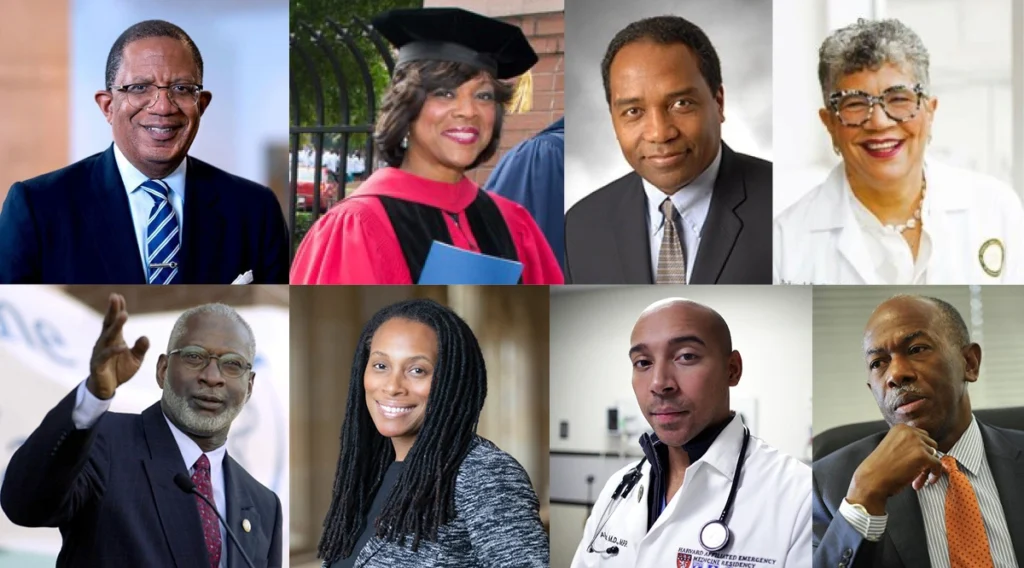
One of the biggest—and least addressed—obstacles to modern Black unity is the quiet distrust we often have toward one another. It’s not imagined. It’s real. Black people talk about it privately, even if we avoid saying it publicly.
But where does this distrust come from?
1. Historical Trauma
Centuries of slavery, where people were forced to betray one another for survival, left psychological scars. Divide-and-conquer tactics weren’t occasional—they were constant. That generational wound didn’t disappear; it evolved.
2. Colorism and Internal Hierarchies
From plantations to present-day media, internal hierarchies—based on skin tone, hair texture, proximity to whiteness—have created resentment, insecurity, and competition that weaken unity.
3. Economic Scarcity
In communities where resources feel limited, people begin to see each other as competitors rather than collaborators. Scarcity breeds suspicion.
4. Crabs-in-a-Barrel Conditioning
For generations, society taught us that “only one” could succeed—the one Black star, the one Black CEO, the one Black student in the gifted program. When a community is conditioned to believe success is limited, unity becomes optional.
5. Media Narratives
For decades, media—news, film, reality TV—has reinforced images of dysfunction, conflict, and betrayal among Black people. When the world expects chaos, we sometimes internalize it.
This distrust affects business partnerships, collaborations, political organizing, and even simple day-to-day interactions. And whether we say it out loud or not—every Black person reading this knows exactly what this means.
It is one of the primary barriers to rebuilding a new Renaissance.
Searching for Today’s Voice
I try to name a Black political leader that moves the masses today—and the list runs short. Jasmine Crockett stands out, fierce and unbothered, but beyond her? Silence. Hollow space. A generation without a clear front line.
We do have wealthy Black public figures—Oprah, Tyler Perry, high-profile entertainers, moguls—but not many who take on the mantle of movement. Their contributions are real, but the era of leadership that was willing to risk something substantial for collective empowerment has been replaced by corporate caution, curation, and quiet comfort.
Even modern athletes—once the brave moral compass of America—often stay silent.
And the ones who don’t, like Colin Kaepernick, pay a price so steep it scares others from stepping forward. His exile was swift and calculated. But even more painful was the absence of unified, unwavering Black support.
In previous eras, that man would not have stood alone.
A Culture Once Sharpened By Pride
There was a time when Black people carried excellence like armor—how we dressed, how we spoke, how we groomed ourselves, how we moved. It wasn’t arrogance; it was survival. It was an identity. It was a legacy.
Today?
- Reality TV profits from Black dysfunction.
- Music and entertainment often reward the most controversial caricatures.
- Some public figures seem lifted more by spectacle than substance.
- Networks devoted to Black audiences routinely promote us fighting one another for ratings.
Contrast that with other communities—Jewish, Asian, Latino, and White—where internal empowerment is a cultural cornerstone. They pass resources through generations. They build institutions. They practice unity like ritual.
Meanwhile, we often practice survival as individuals instead of strength as a collective.
And the truth is: we know this.
Black people talk about this quietly in private circles, even though speaking it aloud feels taboo. It’s the unspoken tension in our community—visible to us but rarely addressed head-on.

Leaders in Tech—Where Are They Now?
One area where this leadership vacuum stings the most is technology.
There was a moment when Black technologists, engineers, and innovators were on the rise—pushing boundaries, founding startups, shaping early digital culture. Yet today, that potential feels overshadowed by something… shallower.
Instead of celebrating Black leaders in AI, robotics, data science, or cybersecurity, the spotlight has shifted toward streamers, reaction personalities, and internet comics who build fame on pranks and spectacle.
Nothing is wrong with entertainment.
But the issue is proportion.
Where we once uplifted innovators, thinkers, strategists, and builders, we now often elevate:
- prank channels
- social-media feuds
- clout-based comedy
- reaction content
- viral antics that evaporate in 24 hours
Meanwhile, we have almost no major Black voices leading AI ethics, machine learning innovation, robotics advancement, or software breakthroughs—areas that will determine the next century of power and opportunity.
This cultural shift matters because technology is the new global currency, and while other communities are forming AI think tanks, teaching their kids coding, and building tech ecosystems, we are pouring our attention—and our money—into entertainment that has no long-term value.
It isn’t that talented Black technologists don’t exist.
They do.
But they are outshouted, out-viewed, and overshadowed by an algorithm that favors chaos over craft.
We are trading brilliance for noise.
Future for distraction.
Potential for virality.
And that imbalance will cost us.
When Spiritual Leadership Falters
Even the spiritual anchors of our community have lost some credibility. Scandals, greed, performative sermons—these fractures have distanced many from the very institutions that once held us together.
The church used to be a safe space. The sanctuary. The strategy room.
Now, for some, it feels like a stage for ego or exploitation.
That void matters.
What Becomes of a People Without Heroes?
Maybe age has sharpened my lens.
Maybe being in my forties has made legacy feel heavier, more urgent.
But I look at our landscape—politically, socially, culturally—and wonder:
What happens to people who lose their examples?
What happens when the torch isn’t picked up?
We have less power today, across industries, than we have had in decades.
The Black vote didn’t show up with full force in the last election, and it shifted the entire political trajectory of this country. Not because one candidate was a savior, but because disengagement is a form of surrender.
Our ancestors didn’t fight for our right to vanish from the process.
A Call to Reignite the Renaissance
This is not a eulogy.
This is a summons.
The renaissance we miss won’t be resurrected by one magnetic leader. It will be revived by us—by rebuilding our unity, our dignity, our accountability, and our communal expectations.
We must remember:
- Our roots are royal.
- Our ancestors were innovators, thinkers, and revolutionaries.
- Our culture has always led the world—even when the world refused to acknowledge it.
The renaissance can be reborn, but only if we choose to stop whispering and start acting.
Only if we return to the idea that our strength is collective, not individual.
Right now, the world is watching.
Let’s show them a rebirth—not a decline.
FAQs
1. What does “Black Renaissance” refer to?
It describes eras of explosive Black creativity, leadership, unity, and cultural progress—like the Harlem Renaissance and the civil rights movement.
2. Why does it feel like Black leadership is fading?
Fragmentation, economic pressures, media narratives, and a shift from communal responsibility to individual success have created a leadership gap.
3. Aren’t there strong Black leaders today?
Yes, but few with the broad, mobilizing force of figures like Malcolm X or Thurgood Marshall. Influence today is diluted across social media and entertainment.
4. How can the Black community rebuild unity?
Through consistent voting, supporting Black-owned businesses, mentoring youth, building institutions, and rejecting narratives that divide us.
5. What role should celebrities and athletes play?
They don’t have to be activists, but their platforms are powerful. Using them responsibly can encourage empowerment, awareness, and collective progress.
About the Author
Charles Mattocks is an award-winning filmmaker, actor, author, and global health advocate. The nephew of reggae legend Bob Marley, Charles has devoted his life to raising awareness about chronic illness, health equity, and personal empowerment. His groundbreaking television projects — including Reversed and Eight Days — have aired on major networks and inspired audiences worldwide. Through his work in film, writing, and health media, Charles continues to champion wellness and the importance of evidence-based care across communities.